Cold Plasma vs. PlasmaChanneling®: Understanding Two Approaches to Skin Rejuvenation and Product Delivery
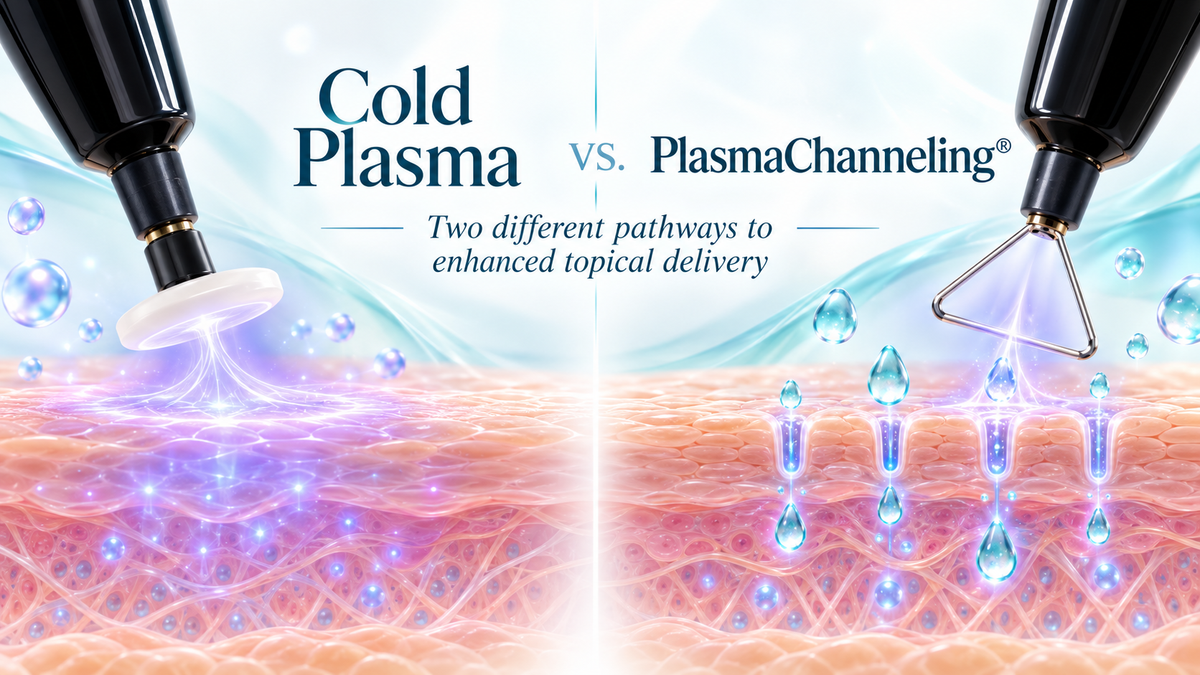
Cold Plasma and PlasmaChanneling® both use plasma technology to support professional skin treatments, but they work in very different ways. Cold Plasma temporarily increases skin permeability without intentionally creating channels, while PlasmaChanneling® creates controlled superficial pathways through the skin’s outer barrier to enhance topical access. This article explores how each technology works, why the distinction matters, and when one approach may be preferred over the other.
The skin is remarkably good at doing its job. Its outermost layer, the stratum corneum, serves as a protective barrier designed to keep harmful substances out while preventing excessive water loss from within.
That protective barrier is also one of the greatest challenges in professional skincare. Many beneficial topical ingredients have difficulty moving beyond the skin's surface simply because healthy skin is specifically designed to resist penetration.
Two technologies, among six total available with the LUXEplaxel® — Cold Plasma and PlasmaChanneling® — approach this challenge in very different ways. Although both use plasma technology, they should not be confused with one another.
Cold Plasma works primarily by temporarily changing the properties of the skin barrier without intentionally creating physical channels. PlasmaChanneling® uses controlled surface channeling to create temporary pathways through the outer barrier.
Key takeaways
- Both technologies use plasma, but they interact with the skin barrier differently: Cold Plasma changes its properties, PlasmaChanneling® creates controlled channels through it.
- Cold Plasma does not intentionally create channels. Effects come from temporary changes to barrier lipids, electrical field effects, reactive oxygen and nitrogen species, and increased surface wettability.
- PlasmaChanneling® is a proprietary Plaxel protocol, not microneedling. It uses plasma energy, not mechanical needles, to create the channels.
- Increased skin permeability does not mean any product can be driven deep into the skin. Penetration still depends on molecular size, charge, solubility, and formulation.
- Neither technology is universally "better." Selection depends on the client's skin, goals, and the practitioner's treatment plan.
Plasma is the fourth state of matter
Plasma is often called the fourth state of matter, after solids, liquids and gases.
When sufficient energy is introduced into a gas, some of its atoms and molecules become electrically charged. The resulting plasma can contain electrons, ions, excited molecules, electric fields and reactive oxygen and nitrogen species.
Not all plasma is the same. Depending on how it is generated and delivered, plasma can interact with tissue in dramatically different ways. Some forms of plasma create significant heat and controlled tissue effects, while cold atmospheric plasma can be produced at temperatures compatible with living tissue. This versatility is what makes plasma technology so interesting in dermatology and aesthetics.
How Cold Plasma interacts with the skin
Cold Plasma does not need to remove the outer layer of skin or intentionally create visible channels to interact with it. Instead, exposure to cold atmospheric plasma can temporarily influence the physical and chemical properties of the stratum corneum. Research has shown several mechanisms that may contribute to this effect.
1. Temporary changes in skin barrier lipids
The stratum corneum is sometimes described as a "brick-and-mortar" barrier. The skin cells are the bricks, while lipids — including ceramides, cholesterol and fatty acids — form much of the mortar between them.
Cold Plasma can modify components of these surface lipids. These temporary changes can increase skin permeability and make it easier for appropriately formulated topical ingredients to interact with the superficial layers of the skin.
2. Electroporation-like effects
Cold Plasma also produces electrical fields and charged particles. Research into plasma-assisted transdermal delivery suggests these effects can temporarily increase permeability through mechanisms that include electroporation, in which electrical energy changes the permeability of biological membranes. Importantly, this is different from physically puncturing the skin.
3. Reactive oxygen and nitrogen species
Cold Plasma generates carefully controlled amounts of reactive oxygen and nitrogen species, often abbreviated RONS. Although the words "reactive oxygen species" are sometimes associated only with oxidative damage, these molecules are also naturally involved in cellular signaling.
In controlled concentrations, RONS participate in numerous biological processes associated with cellular communication, inflammation, antimicrobial activity and tissue responses. The amount and type of reactive species produced can vary considerably depending upon the plasma device, treatment parameters, distance from the skin, surrounding gas and treatment duration.
4. Increased surface wettability
Plasma treatment can also make surfaces more hydrophilic, meaning more receptive to water. In skincare applications, this may allow water-based formulations to spread and interact more effectively with the treated surface.
What does this mean for topical skincare?
Together, these effects can create a temporary environment in which the skin is more receptive to certain topical ingredients than untreated intact skin.
Think of Cold Plasma as temporarily changing the behavior of the skin's front door rather than physically making a new doorway. The barrier is still present, but its permeability has temporarily changed.
How PlasmaChanneling® is different
PlasmaChanneling® takes a different approach. Rather than relying primarily on temporary biochemical and electrical changes to an intact stratum corneum, PlasmaChanneling® uses a dedicated treatment tip and controlled plasma energy to produce superficial channels within the skin's outer barrier.
These channels provide temporary pathways through an otherwise highly resistant surface. Aftercare products and professionally selected topical formulations can then be applied to the treated skin.
The concept of creating temporary microchannels to improve topical delivery is well established within transdermal-delivery research. When temporary pathways are created through the stratum corneum, substances that would otherwise have difficulty crossing the intact skin barrier may have greater access to superficial skin layers.
PlasmaChanneling®, however, is its own proprietary treatment protocol and should not be confused with microneedling. The method used to create the channels is different.
Cold Plasma vs. PlasmaChanneling®: the simplest explanation
Think about the stratum corneum as the protective wall surrounding a building.
With Cold Plasma, we temporarily change certain characteristics of the wall, making it more permeable without intentionally creating openings through it.
With PlasmaChanneling®, we intentionally create controlled, temporary superficial pathways through that wall.
Both approaches can be useful. They simply accomplish their goals differently.
| Cold Plasma | PlasmaChanneling® | |
|---|---|---|
| Primary interaction with skin | Alters properties of the skin surface and barrier | Creates controlled superficial channels |
| Intentionally creates channels? | No | Yes |
| Uses plasma technology? | Yes | Yes |
| Topical delivery approach | Temporarily increases skin receptivity/permeability | Provides temporary pathways through the outer barrier |
| Typical skin disruption | Non-ablative | Controlled surface channeling |
| Downtime | Typically minimal | Little to no downtime with the PlasmaChanneling® protocol |
| Can be combined with professional topical products? | Yes, when appropriately formulated | Yes, as part of the treatment protocol |

Is one better than the other?
Not necessarily. They are different tools designed to interact with the skin differently.
Cold Plasma may be particularly useful when the goal is to influence the skin environment while maintaining an essentially intact surface. PlasmaChanneling® may be selected when a practitioner wants the additional advantage of controlled surface channeling and enhanced access through the stratum corneum.
Treatment selection should depend on the client's skin, goals, products being used and the professional's treatment plan. In some professional protocols, these technologies may even play complementary roles rather than competing ones. Both are included among the six modalities of the LUXEplaxel®.
Does this mean any product can be driven into the skin?
No, and this distinction is extremely important.
Enhanced permeability does not mean that every substance placed on the skin will automatically travel deeply into it. Ingredient penetration is affected by many factors, including:
- molecular size
- molecular charge
- water or lipid solubility
- concentration
- formulation
- vehicle or delivery system
- condition of the skin
- treatment parameters
- duration of exposure
- depth and characteristics of any channels created
Professional topical delivery therefore involves much more than simply applying a serum after treatment. Products used with treatments that alter skin permeability should be selected specifically for that purpose.
Two technologies, two different pathways
Cold Plasma and PlasmaChanneling® illustrate something fascinating about modern plasma technology: the same broad field of physics can be used to interact with skin in very different ways.
Cold Plasma can temporarily influence skin chemistry, surface characteristics and barrier permeability while leaving the surface essentially intact. PlasmaChanneling® takes a more direct approach by creating controlled superficial pathways through the outer barrier.
The goal is not to determine which technology is universally "better." It is understanding which interaction with the skin is appropriate for the treatment being performed. As research into plasma medicine, skin permeability and topical delivery continues to expand, our understanding of how plasma can be used in professional skincare continues to grow as well.
Cold Plasma and PlasmaChanneling® FAQ
What's the main difference between Cold Plasma and PlasmaChanneling®?
Cold Plasma temporarily changes the skin barrier's permeability without intentionally creating channels. PlasmaChanneling® intentionally creates controlled, temporary superficial channels through the barrier. Both use plasma technology, but the mechanism is different.
Is PlasmaChanneling® the same as microneedling?
No. PlasmaChanneling® is a proprietary plasma-based protocol. The method used to create the channels is different from microneedling's mechanical needles.
Does increased skin permeability mean any product can be driven deeper into the skin?
No. Penetration still depends on molecular size, charge, solubility, formulation, and other factors. Products used alongside either technology should be formulated specifically for that purpose.
Is one technology better than the other?
Not universally. Treatment selection depends on the client's skin, goals, and the practitioner's treatment plan. In some protocols, the two technologies play complementary roles rather than competing ones.
Is there downtime with either treatment?
Both are typically associated with minimal downtime. PlasmaChanneling® in particular has little to no downtime as part of its protocol.
Important: PlasmaChanneling® is a proprietary LUXE Plasma® protocol performed with the LUXEplaxel® device. Information regarding cold atmospheric plasma and skin permeability is based on published research involving various cold atmospheric plasma technologies. Results and biological effects can vary according to the device, energy output, treatment parameters, treatment duration, topical formulation and individual skin characteristics. This information is intended for educational purposes and should not be interpreted as a claim that all published findings involving cold atmospheric plasma apply specifically to every plasma device or treatment protocol.
Sources:
https://pubmed.ncbi.nlm.nih.gov/40639635/
https://pubmed.ncbi.nlm.nih.gov/33285323/
 Best Plasma Fibroblast Pen of 2026: True Plasma vs Electric Pens for Licensed Professionals
Sep 10, 2026
Best Plasma Fibroblast Pen of 2026: True Plasma vs Electric Pens for Licensed Professionals
Sep 10, 2026
 How to Perform a LUXEplaxel® Facial
Apr 14, 2026
How to Perform a LUXEplaxel® Facial
Apr 14, 2026
 Harnessing TRUE PLASMA for Cutting-Edge Skin Rejuvenation Technology
Jul 31, 2025
Harnessing TRUE PLASMA for Cutting-Edge Skin Rejuvenation Technology
Jul 31, 2025
See PlasmaChanneling® for yourself.
The free Starter Course walks through the LUXEplaxel®, the serums and real before-and-afters in five short lessons.